
Effective Sourcing: A Case Study on Strategic IT Globalization
by Dr. Julia Schreier, Jonas Pfeifer
Overview
In the evolving landscape of IT, the transition from mere computer management to becoming a strategic business partner has introduced significant complexities for IT management. Particularly challenging is finding the right personnel with the necessary expertise while keeping costs under control. The question arises of whether to opt for onshore, offshore, nearshore or external solutions and their consequences on the resource pool and costs. Additionally, CIOs ask themselves how they can answer this complex question while lacking knowledge about costs and resources and dealing with all the daily operational tasks. Only 20 percent of organizations excel in such decision making, whereas most managers despite using 37% of their time for decision making state that they are ineffective in decision making (McKinsey, 2019). Therefore, CIOs think about tools that support them in management and decision making.
Accordingly, this case study gives answers to these four questions:
- How can IT efficiently manage increasing complexity due to growth in terms of personnel (with the right expertise) and costs?
- How can IT management handle growth and the associated organizational changes in sourcing?
- How can the complexity of onshore, nearshore, and offshore resources be managed?
- How can consulting and tools like Bee360 help in managing this complexity?
The answers are showcased via the example of Phoenix Contact. Their challenges manifested themselves in three points. First, Phoenix Contact had problems with gathering consistent information, especially distributed data. They were lacking an integrated system and a systematic approach to managing operations. Second, they desired to manage their portfolio, value, and costs better. Third, Phoenix Contact needed to effectively manage its growth and globalization. This necessitated the implementation of a centralized system (Bee360) capable of supporting local operations within a global enterprise, as the company was undergoing a transformation from a local German entity to a global organization. The case study included five years of experience using Bee360 and an interview with the CIO of Phoenix Contact, Guido Küster.
In sum, this approach with Bee360 introduced a level of transparency that enhanced clarity, simplicity and decision making. This was accomplished with holistic cost and resource management, as well as the execution of sourcing decisions. Consequently, the IT management of Phoenix Contact became more effective on a global scale.
By following this approach, CEOs, CIOs, and leaders will gain control over complexity. This will improve steering, planning, efficiency, and delivery.
1. Transforming to a Globalized Enterprise
The IT's journey from managing computers to becoming a strategic business partner has been marked by milestones and challenges. Initially, IT departments focused on maintaining and managing computer systems. Over time, the role of IT has expanded to include strategic planning, process optimization, and innovation. This evolution comes with increasing complexity of IT management and the need for specialized skills and knowledge. As organizations grow and try to manage complex tasks, the complexity of their systems also increases (Goydan, Kelley, 2024). For example, different tools are used for different management areas – e.g., one for cost management, one for portfolio management and another for capacity management etc. Overall, all these aspects must be considered when deciding on strategic roadmaps. A more efficient approach and avoid work in different systems is to implement a system that integrates all necessary information. Thus, we derived the following solution hypothesis:
During economic downturns, one important factor that influences decisions is cost pressure. In these situations, it is important to take advantage of cost benefits by doing business on a global scale (BCG, 2025). This leads to the second hypothesis:
However, an international workforce also introduces challenges such as reduced proximity, lack of transparency e.g., an employee cannot directly enter the office room of a colleague, and cultural differences which could lead to misunderstandings, less trust and thus less efficiency (Taras et al., 2021). Distance also leads to delayed cost visibility and monitoring difficulties which increase control and coordination costs and complicates management steerability (Handley, Benton, 2013). Other factors that need to be managed are remote onboarding, language, and time zone differences. This comes closely with ensuring seamless interaction between local and central IT functions. For example, regarding a balanced capacity utilization of local and central IT functions incentive structures can be used. However, these need to be carefully considered as for example an incentive on cost optimization accordingly leads to favoring cost-effective resources, which can result in not choosing the most suitable resources and thus a reduction in quality (Bulte et al., 2021). The same is applicable for defining responsibilities clearly and balancing local autonomy with centralized control. Questions such as how much autonomy local people have, for instance to buy software, and who is in charge of the local services – a central or a local manager - need to be answered. To approach these points, the following solution hypothesis is made:
To better manage the complexity and growth, the consulting and tool of Bee360 is used. This results in the last hypothesis:
This case study tests these hypotheses and provides insights into the effective management of IT complexity in a growing and globalizing organization. First, the initial situation of Phoenix Contact is explained. Second, the procedure of the transformation to a global company and how Bee360 helped is outlined. Third, the results of this approach of deciding with transparency and using Bee360 are shown. And finally, there is an outlook on the next action steps Phoenix Contact wants to pursue in the future to further manage their IT better.
2. Case Study from Local to Global
Initial Situation of Phoenix Contact: Need to Manage Growth, Labour Costs and Resources
Phoenix Contact needed to manage its labor costs and resources during its growth. The goal was to plan and balance which resources to build up in which regions. They started with 80% local. Thus, the start had to be set with the headquarters and the central IT management. The main questions to address were what key performance indicators were needed and how to manage costs and resources. One of the advantages of IT at that time was that it was allowed to set up its own structures for its global IT management needs. In this way, IT could avoid getting caught up in the more generic guidelines of corporate controlling focusing on the business. Within three years, the company's IT workforce was globalized (Americas, India, Poland). The number of IT employees grew from 100 to 390 at the headquarters in Germany and 130 at the hubs.
Procedure: Using Bee360
Guido Küster, the CIO of Phoenix Contact, used Bee360, which supported transparency and steerability on his sourcing, cost and resource issues. By providing a centralized transparent system, Bee360 enables effective management and the derivation of the right incentives. First, Phoenix Contact established IT governance structures and set up projects and services effectively with a comprehensive resource management. They performed well and in a timely manner via a significant joint effort, a robust change management concept, and a strong team.
They then managed the economic cost pressure with globalization. They set up service centers in India, the Americas, Poland, and Spain. Besides saving money, having experts on hand was also important. For example, it took 90 days to hire SAP specialists in Spain, but in Germany it took 8 to 14 months. Initially, these nearshore and offshore personnel costs were managed as a cost block. This means that the incoming invoice was assigned to the projects and services. However, this was not sufficient for managing the team and its resources. For example, it was hard to steer the value creation and the technical expert setup. As a solution the already well-functioning resource management at headquarters was also introduced for nearshore and offshore personnel.
To manage the onshore, nearshore, and offshore resources two official shared services were set up in India and Poland, and governance structures were considered. At the beginning, they were functionally led from the headquarters. Now, they started a functional management at the hubs with a reporting line to the CIO. Together with the headquarters, they decided on responsibilities and accountabilities, tasks and communication channels.
Additionally, right from the beginning, the management team thought about how to overcome biases internally in IT and on the business side regarding best cost locations. For Phoenix Contact, the solution to reducing existing biases was to create a culture of awareness and communication. Furthermore, by communicating and explaining that everyone in the company is equal, a global corporate culture was developed. Also, professional managers and individual incentives were the solution. For example, management goals included keeping personnel costs in check. As IT and business experienced rising labour costs, the business raised the expectation to see a countertrend and that IT should reduce labour costs. Material costs, like software contracts, do not change much, so the focus was on using resources more efficiently globally. The manager's goals included a goal of performing well abroad. Phoenix Contact also selected highly qualified and experienced people to lead the teams working abroad. This supported the change from local to global. Regarding the charging, the SLA was a mixed calculation of services from the USA, India, Poland, and Germany. The costs were added up and divided by the number of users.
Results: Achieving Manageability to Global Costs and Resources
After the roll-out of Bee360 in headquarters in less than 12 months, Phoenix Contact had already reached a point where improvements and expanding were possible. All employees worldwide now had been using Bee360 to plan and report their time. This information helped all employees and managers to see how much capacity is used and where there were / are bottlenecks or overcapacity. This transparency was not only for the short-term, but also for the mid-term planning of 18 months. This allowed Phoenix Contact to react to the economic situation by replanning the next fiscal year's plans. Questions such as "What projects will the employees be working on?" "Will there be free capacity?" and "How will we deal with this?" can be discussed with the local managers. Accordingly, Guido Küster stated that looking at the capacities of the Phoenix Contact IT, Bee360 is essential.
 Guido Küster, Vice President Digital Processes and Solutions, Phoenix Contact
Excess capacity could be identified, as e.g., with a large SAP implementation project. More than 300 people were involved here. Together with the management colleagues Phoenix Contact could analyse the resource data in Bee360 and find good indicators for phasing out excess capacity and external consultants in such major programs. For example, they found that they could generate relevant savings in a SAP project. For such actions many people within Phoenix Contact quoted: "Nobody would know how to do that if we did not have Bee360."
Whenever a capacity gap was identified, new internal employees were hired. Phoenix Contact implemented a standardized hiring process with global approval levels, which is enabled by Bee360.
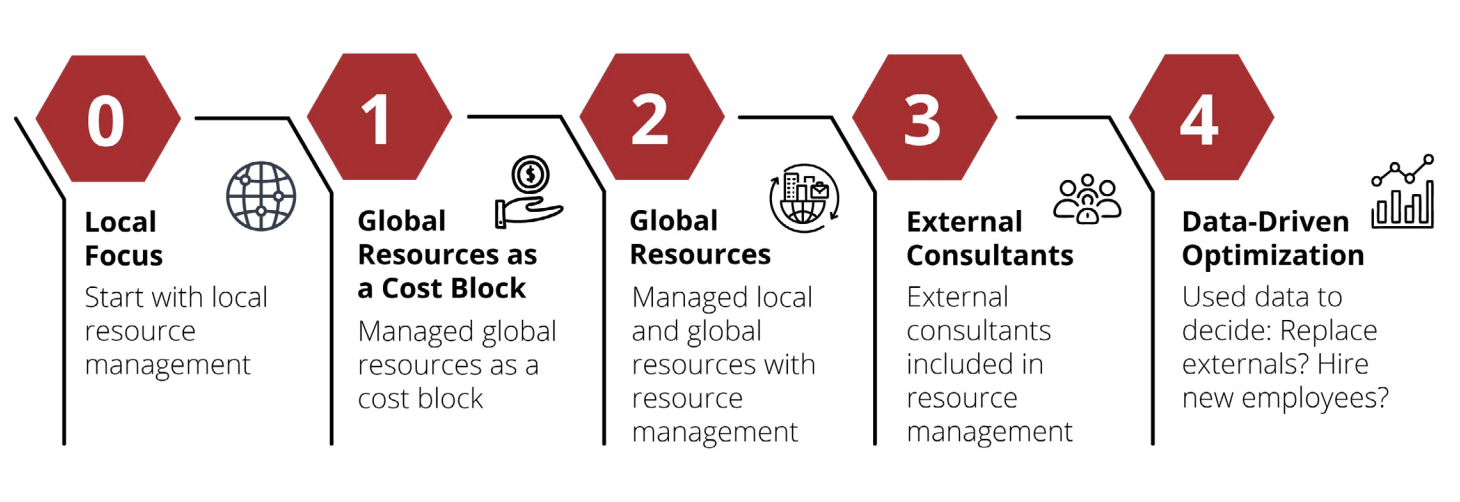
In this way, Phoenix Contact moved from onshore resource management to global resources, which were firstly managed as a cost block. Secondly, not only local but also global resources were managed. Thirdly, they included external consultants in their resource management. Finally, they were able to decide on a data basis whether external resources should be phased out or replaced by internal resources, or whether bottlenecks required new employees.
Thus, reducing complexity through a single system and achieving transparency enabled effective management and appropriate incentives (H1).

Phoenix Contact started with the prospect of offsetting traditional labour costs increases in Germany by using cost advantages in other countries. This goal could be achieved through strategic planning, as the cost development could well be controlled. In addition, the transparency and thus measurability made it possible to set personnel cost targets for managers. And they could achieve it by using offshore, nearshore and onshore resources.
In summary, the transition from a local IT to a global IT structure has enabled and supported global sourcing and cost savings (H2).
The function to analyze the costs of the personnel cost centers directly and in detail was well used. The management had the possibility to see and compare how the average personnel costs developed not only overall, but also e.g., locally in Spain or Germany. This enabled the CIO to incentivize his managers on how the personnel costs in the manager's responsibility should develop. Target hourly labor rates could be discussed and then well measured. A high utilization of Bee360 in terms of self-planning, time reporting and planning accuracy was also achieved in the offshore centers, as the sites could only charge for the time they had reported. Functionally, all the topics and projects in the offshore center came from the headquarters. But the offshore centers could also procure and take responsibility for something locally, if it was their niche topic.
Accordingly, the transition from a local IT to a global IT structure was supported by cost allocation, incentivization, clear responsibilities, patience, and experienced local managers (H3).
Overall, Bee360 supported managing the complexities by enabling transparent, holistic management (H4).
3. Outlook into the Future of Managing Global Costs, External Costs and Resources
Phoenix Contact expects to implement the SAP S/4HANA transformation in 2026. Once all global hubs and the German headquarters are using the same SAP system, the company plans to use Bee360 also for IT financial management globally. This will allow the company to make decisions about e.g., license costs, contracts, and suppliers. Regarding resource management, the next step will be to locally start and manage projects. It will also be extended to include external service providers. Currently, there are several issues with managing external consultants regarding time keeping, invoicing, heterogenous processes for every company so the administrative burden on internal staff is high, leading to inefficiencies. Also, there is a lack of transparency in planning with external service providers, especially for large projects with a large number of external consultants. There is no transparency regarding who manages the consultants' capacities and times. In addition, the number and costs of external staff is significantly higher than the personnel costs. From the beginning of using Bee360, the goal was to integrate and manage external providers in Bee360. Project managers should plan the consultants' time in advance and compare it to the actuals. They can answer questions such as "Am I using the consultants in the right way?", "Are the timeframes reasonable?" This will make project management with externals more efficient and effective. This approach can also resolve arguments about how much buffer time is needed in the plannings. Since the plan is adjusted as needed, this makes buffer time unnecessary. These analyses are possible because everyone is using the same system, which solves the problem of different distributed systems (e.g., Excel).
Guido Küster, Vice President Digital Processes and Solutions, Phoenix Contact4. Reflection with Academic and Consulting Concepts
Offshore operations can seem complicated. Bee360 allows you to manage services across companies. This transparency is especially important when informal communication channels, like those in nearshore setups, are not available. When cross-border communication is difficult, it is important to clearly communicate strategies, demands, and what needs to be done. Bee360 can show these in an easy-to-use format. Bee360 can also help you control costs as it shows the different costs of local employees in comparison to the central employees. Management can then decide strategically on employee numbers at each location and how to allocate the employees to services and projects.
A tabular overview helps with resource allocation by showing local cost centers, where costs are booked and where the employees work. Alongside, it shows the central organizational unit to which the employees functionally contribute. This combined view allows the manager to see the respective needed perspective. The organizational unit managers can see all their resources, including those nearshore and offshore. Cost center managers can see how their employees are being utilized.
Enhanced capacity management involves disciplinary and functional supervisors. It is important to clarify who establishes guidelines and monitors aspects like workload. It is essential to determine who is responsible for managing local services and whether they report to central or local managers. Career paths for colleagues in Spain, Poland, or India should offer both centralized and decentralized opportunities. Outsourcing services or capabilities can address language, cultural, and time zone barriers. Knowing the skills available ensures that resources are used effectively. It is also important to define how local teams can operate independently. This includes things like buying software or managing service tools on their own.
Research shows that there are several factors to consider when thinking about team composition and incentive effects. The effect of incentives can have a big impact on how teams work together and how well they perform. If you put together teams based on costs, it can have a negative effect on quality (Bulte et al., 2021). This is because the teams might end up with members who are not very qualified or have less experience.
Also, the way employees communicate with each other is crucial. Face-to-face communication often helps employees understand each other better and work together better (Taras et al., 2021). Balancing cost efficiency with quality and ensuring effective communication methods are essential for optimal team performance. This could be confirmed from the case study.

5. Lessons from Globalizing via Cost and Resource Management
This case study explores how IT organizations can efficiently manage increasing complexity due to growth and personnel costs and making adequate sourcing decisions. The challenge was to transform from a local IT model to a global structure.
To handle this expansion, Phoenix Contact established comprehensive resource management strategies. Service centers were set up in India, Americas, Poland, and Spain to balance cost savings with access to expertise. Offshore personnel were initially managed as a cost block but was later integrated into the existing resource management system. Functional management evolved from being centralized at headquarters to being handled at regional hubs with a direct reporting line to the CIO.
A key enabler of this transformation was the adoption of Bee360, which provided transparency and enabled better decision-making on hiring, cost allocation, and the use of external consultants.
Looking ahead, the company plans to extend the use of Bee360 by integrating it with a new SAP S/4HANA system by 2026. This will enable a unified approach to managing global costs, contracts, and suppliers. Additionally, the framework will be extended to include external service providers.
The findings from this case study align well with consulting and academic frameworks, demonstrating that transparency over complexity leads to clearer and more effective management. By implementing a seamless, holistic IT system for resource and cost management, Phoenix Contact was able to reduce complexity and optimize sourcing decisions. This approach provides a valuable model for CIOs and business leaders seeking to gain better control over IT complexity, enhancing planning, efficiency, and delivery on a global scale.
References
BCG (2025): "BCG's Guide to Cost and Growth - Strategic Insights for Navigating Economic Uncertainty."
Bulte, Erwin; List, John A.; van Soest, Daan (2021): "Incentive spillovers in the workplace: Evidence from two field experiments." Journal of Economic Behavior & Organization, 184 (2021), pp. 137-149.
Goydan, Paul; Kelley, Kevin (2024): "Don't Wait for a Crisis to Reduce Costs", Harvard Business Review.
Handley, Sean M.; Benton, W. C. Jr. (2013): "The influence of task- and location-specific complexity on the control and coordination costs in global outsourcing relationships." Journal of Operations Management (31.3), pp. 109-128.
McKinsey (2019): "Decision making in the age of urgency."
Taras, Vasyl; Baack, Dan, Caprar, Dan; Jiménez, Alfredo; Froese, Fabian (2021): "Research: How Cultural Differences Can Impact Global Teams", Harvard Business Review.
About the Authors
Dr. Julia Schreier
Bee360, www.bee360.com
▼

Dr. Julia Schreier
Bee360, www.bee360.com
Leveraging experience across different fields - from Industrial Engineering and Management to People, Julia's passion is enhancing knowledge and creating value by exploring and sharing innovative concepts and management insights. A key facet of her expertise involves effectively bridging the gap between academic insights and practical applications, particularly in addressing management topics and organizational challenges. This multifaceted background uniquely positions her to contribute valuable impetus to initiatives aimed at fostering comprehension, continuous growth, and progress.

Jonas Pfeifer
Bee360, www.bee360.com
▼
Jonas Pfeifer
Bee360, www.bee360.com
Jonas is driven by the challenge of providing decision-relevant information in volatile environments with floods of data. His deep financial understanding as well as his cross-industry experience enable him to quickly adapt to the individual needs and requirements of his customers and to holistically view and classify them. As a product manager and management consultant, his aim is to drive transformation in companies in such a way that tangible added value is created in the processes of decision making and organizational management.
Bee360 GmbH is a globally operating independent company headquartered in Karlsruhe, Germany, with other locations worldwide. Since 2003, we have provided management consulting and comprehensive solutions for international corporations and prominent medium-sized companies through our Bee360 platform. This globally unique platform facilitates the integrated management of an organization, covering all essential functions and business areas at the appropriate level, thus providing a unified perspective on the company's activities for all employees across the organization.
Download PDF