Your People Are Fully Booked. Your Strategy Is Not Getting Done.
The IT capacity problem is not about headcount. It is about visibility — and most organizations are managing blind.
For: CIO, VP of IT, Director of IT Operations, COO in construction and manufacturing
The Numbers Behind the Problem
The Challenge
The capacity is there, in theory.
In practice, it is already committed.
Where IT capacity goes
Key figures
The pattern
Always busy, always behind
High utilization every week. And yet the AI initiative, the platform modernization, the COO's workflow — all perpetually delayed by a week, then a month, then a quarter.
The default response
Add it to the list
When a new priority arrives, the default is to absorb it rather than make an explicit trade-off. The plan grows. The capacity does not.
The solution — organizational, not technological
A shared model of capacity and work
Trusted by leading organizations








What Analysts and Leaders Are Saying
Balancing available resources against demand for those resources is essential to successful initiative completion.
If IT is not viewed by the company as a highly strategic asset, those conversations will have to happen sooner than later — upskilled staff will be highly attractive to poachers if not kept engaged and compensated.
The Bee360 Solution
Managing IT Capacity Starts with Knowing Where It Goes
Most IT organizations cannot answer that question with precision: they know their headcount, their payroll, and their project list, but they do not have a current, integrated view of how individual capacity is being deployed across services, active projects, and operational work. Bee360's capacity management approach builds that view systematically — starting with the service structure that defines run-the-business commitments, then layering in project and initiative demand, and finally surfacing the gap between what is committed and what is available.
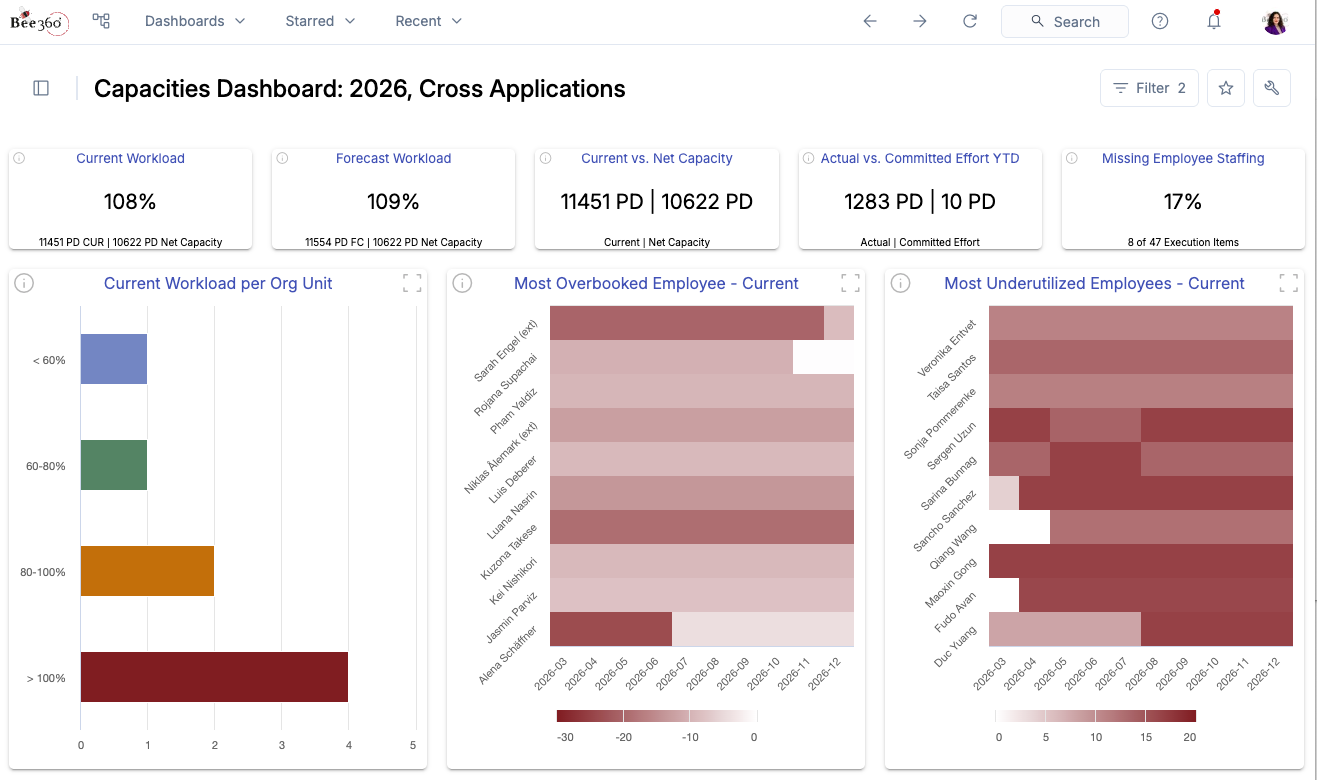
When that view is connected to rolling financial planning, the CIO can answer not just “where is my team's time going” but “what does that capacity cost, and what is it producing.” That conversation — specific, current, and grounded in data — is the one that turns a resource allocation disagreement into a strategic decision.
Analyst recognition: Gartner recognizes Bee360 in the Market Guide for Digital Twin of an Organization (2024), which explicitly covers the capacity and resource management use case within an integrated IT governance platform.
Proven Results
Results Across Industries
Leading organizations trust Bee360 to transform their IT governance. These are measurable outcomes — not theoretical projections.

Orchestrating digital transformation for over 900 stakeholders. Reduction of the global performance billing process from weeks to one day with automated planning.

Complete IT transformation achieving 360-degree visibility across global operations. From Excel-based planning to integrated IT management.

IT transformation from reactive cost center to strategic business partner. IT maturity achieved in 1 year that typically takes 3–5 years according to Gartner benchmarks.

"Despite the COVID-19 pandemic and a major organizational change, we were able to secure fiscal year planning in Bee360 in a very short period of time. With the concepts of Clausmark and Bee360, we achieved financial transparency across the entire CDO and IT portfolio."


"With Bee360's capacity management, I have a clear view of the time our team spends on daily IT services and ongoing optimizations. This allows me to demonstrate solidly that our IT department is already heavily involved in projects, and that prioritization is necessary."

Have Questions? Get in Touch With Us.
Grab 15 minutes with our team — no product pitch, just straight answers.
Just 15 minutes
Fast, no-pressure answers
Ask us anything about Bee360
No commitment required